
Composer Earle Brown wasn’t shaped by any one tradition. His musical identity was a vibrant mix of jazz roots, classical training, abstract art, and literary experimentation. Here’s how these influences helped define one of the most innovative voices in 20th-century music.
Earle Brown’s Jazz Background
Brown started as a trumpet player, deeply involved in jazz and popular music from a young age. He played in a band and organized his own dance band in high school. This jazz background influenced his interest in the flexibility and improvisatory aspects of music. He saw his open-form approach as a natural outgrowth of the freedom and flexibility found in jazz performance, where each iteration of a piece, such as “How High the Moon,” is unique yet recognizable. Brown felt the influence was not necessarily in the sound of his music but in the “poetic relationship” to the act of performing and the conversational nature of jazz improvisation. He noted that Cage had no connection with or liking for jazz or improvisation, distinguishing his own background.
Classical Training and Serialism
Brown studied composition at the Schillinger School and privately with the twelve-tone composer Roslyn Brogue-Henning in Boston. Henning introduced him to classical music, including Schoenberg, Berg, and Webern. He studied Berg’s Violin Concerto extensively. He initially found composers like Bartók, Berg, and Ives enticing and gravitated toward them rather than earlier classical composers like Beethoven or Haydn. He felt a connection to Ives and Varèse, seeing his own sound worlds as environments, similar to theirs. He knew Varèse very well and was friends with him.
Schillinger’s Math-Based Methods
Brown studied and later taught Joseph Schillinger’s techniques of composition, which were based on mathematics and graphical procedures. Schillinger’s work involved exhaustive examinations of proportions, balances, and symmetries, expressed numerically, which assisted Brown in his early composing. His early works from 1951-52 were described as strict, Schillinger-based 12-tone serial works. Brown linked Schillinger’s research to serialism and saw parallels with the structural work of Messiaen and Boulez.
He later incorporated Schillinger principles, such as “density as a primary component” based on statistically calculating density factors, in pieces like Pentathis (1957). Schillinger’s idea of a “master sonority” or “superchord” was also used in conjunction with open-form notation in Time Spans (1972). Brown described Schillinger’s approach as mathematical/arithmetical but no more so than a simple formula like the jazz 2-5-1 cadence.
Abstract Expressionism & Graphic Scores
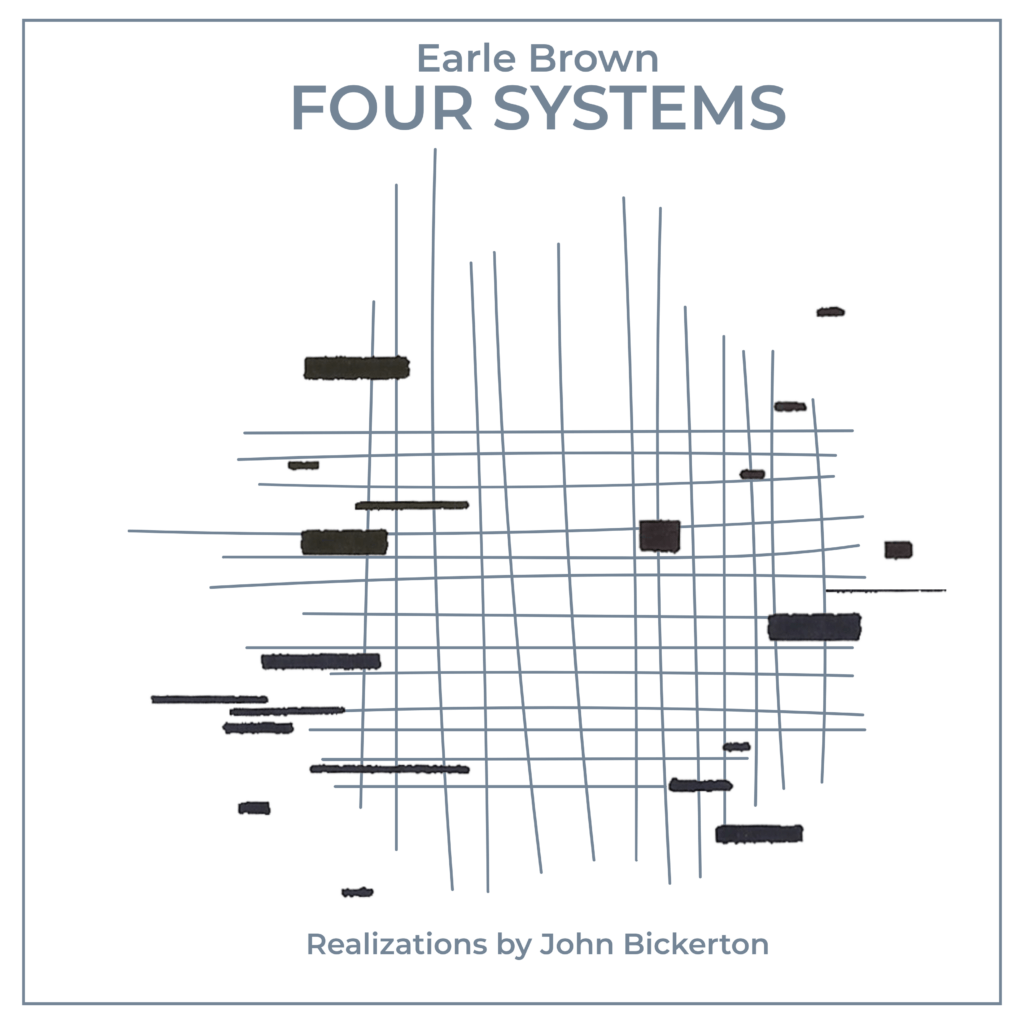
The immediacy and spontaneity of artists like Jackson Pollock and Willem de Kooning profoundly influenced Brown. He was also influenced by Alexander Calder’s mobiles. Calder’s mobiles were key to his open-form scores. He wanted to bring the spontaneous gesture found in painting into music, which he achieved with open forms. He saw a correlation between the technical and aesthetic viewpoints of Calder and Pollock that became a primary motivation for his work. Brown’s graphic scores, like December 1952 and Four Systems, which use rectangles to suggest mobile sound elements, are noted as resembling abstract expressionist drawings. He was very close to the visual arts world, both personally and through his wife, who was a curator. He and Morton Feldman hung out with de Kooning and Mark Rothko, and Brown associated with Robert Rauschenberg,
Literature: James Joyce, Gertrude Stein
Brown was inspired by writers like James Joyce and Gertrude Stein. He set Stein’s piece Tender Buttons early in his career. The idea that anything can follow anything, similar to how one can read Joyce’s Finnegans Wake from any point, informed his open form and Cage’s chance music. Brown felt that the ambiguity in the works of Joyce and Stein allowed the reader to become part of the creative process, which he paralleled to the conductor’s creative input in his music. He also perceived the notion of musical “events” through his reading of Henri Bergson. Kenneth Patchen’s poetry was also an influence.
Beyond the New York School
While often grouped with Cage, Feldman, and Wolff in the New York School, Brown emphasized the significant differences in their approaches. He admired Cage but never wanted to write music like he did, differing in philosophy and aesthetics.
Brown’s approach, particularly his open form and graphic notation, was seen as more tangible and practical than Cage and Feldman’s more philosophical influence. His career led him to Europe and through the 1970s he spent most of his time there. Brown’s exposure in Europe, facilitated in part through prior connections made via John Cage and David Tudor, led to him becoming a frequent visitor and a respected figure within the European avant-garde, securing commissions and lecturing opportunities like those at Darmstadt. These commissions were instrumental in establishing his recognition as a leading avant-garde figure in Europe as well as America He was embraced by European composers that included Xenakis, Boulez, Kagel, Berio, and Bruno Maderna.
A Non-Academic Path to the Avant-Garde
Brown was entirely self-made. His career path, moving from jazz to classical studies and then becoming a leading avant-garde figure, was described as “unorthodox” and “not an academic way,” which he felt left him free from being an academician conceptually. He saw his compositional journey as a natural step driven by dissatisfaction with the limitations he encountered at each stage.
Selected Discography

Feldman/Brown (1962) on Time Records. From 1960 to 1963 composer Earle Brown produced the Contemporary Sound Series for the label which was the first publication of many avant-garde works. Includes Brown’s Music for Violin, Cello and Piano, Music for Cello and Piano, and Hodograph I.

Earle Brown – The music of Earle Brown (1974) on CRI (Composers Recordings Inc.). This catalog is now managed by New World Records. Includes performances of Times Five, Octet I For 8 Loudspeakers, December 1952, Novara.

Earle Brown – Selected Works (1952-1965) New World Records. 2 CD compilation. This long-awaited reissue of the CRI recording of Earle Brown’s (1926–2002) music is the best overview of his seminal early works.

Centering – The Music of Earle Brown (1998) on Newport Classic. This is a great collection of mostly later-era Brown works featuring Centering (1973), Windsor Jambs (1980), Tracking Pierrot (1992), and Event: Synergy II (1967-68).

Our own release, Simple Harmonic Motion’s inaugural Atlas Eclipticalis – The Music of John Cage and Earle Brown. This album features performances of two of Brown’s graphic scores from his Folio collection – November 1952 and December 1952.