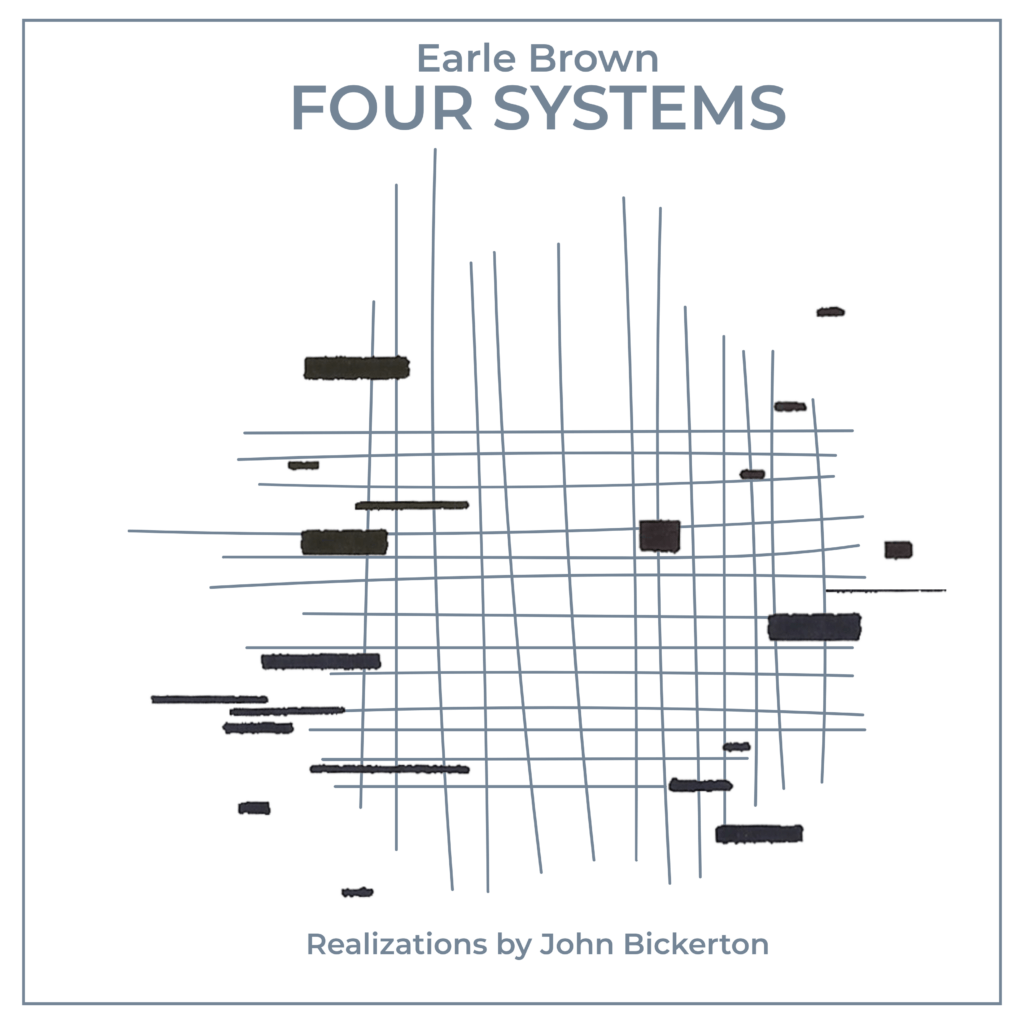

Four Systems is a landmark “open-form” graphic score composed by Earle Brown on the afternoon of January 20, 1954. It was created as a spontaneous birthday present for pianist David Tudor while Brown and John Cage were backstage at the Brooklyn Academy of Music during a Merce Cunningham Dance Company rehearsal. The work was later included in Brown’s influential collection of experimental notations titled Folio.
Indeterminacy
Earle Brown’s composition Four Systems marks a radical shift toward indeterminate music that prioritizes spontaneous process over static (completely notated) results.
Brown’s works, composed between 1952 and 1954, use ambiguous graphic notation to elicit unique, immediate responses from performers rather than prescribing fixed notes. The scores are designed as mobile structures, allowing limitless variations in instrumentation and duration based on the specific conditions of each performance.
By allowing sound to unfold as a continuous process, Brown invites musicians to act as catalysts in an open-ended creative event. Many existing recordings document decades of diverse interpretations and high-profile collaborations, including significant use of the music in Merce Cunningham’s choreography.
Ultimately, these sources highlight a musical philosophy in which the composer, performer, and audience participate in a constantly evolving auditory experience.
Visual Structure and Notation
The score comprises a single page with four horizontal areas, or systems, delineated by thin lines. Within these systems, Brown placed broader horizontal strokes of varying lengths and thicknesses.
These graphic elements serve as visual catalysts for sound, where:
- Vertical position indicates relative pitch or frequency (high or low).
• Horizontal length indicates the duration of the sound (long or short).
• Line thickness or width represents dynamics (volume) or the use of clusters.
• Continuous lines extending across the page define the outer limits of a keyboard (Four Systems can be performed with any type of ensemble, not just piano. In the case of an ensemble performance, the continuous lines represent the outer limits of the instruments involved).
The “Mobile” Concept and Performance
Brown described “Four Systems” as a “mobile musical piece,” a concept he adapted from the kinetic sculptures of Alexander Calder. His goal was to create a work that functioned as an endlessly transforming “organism” rather than a static, conclusive object. Key performance aspects include:
- Variable Instrumentation: The piece can be realized by any number or type of sound-producing means, ranging from solo piano to electronic media.
- Performer Autonomy: Musicians are responsible for translating the visual graphics into audible music through spontaneous determination of parameters like timbre and rhythm.
- Navigation: Performers can begin at any point and move through the score in any sequence, at any tempo, and even with either side of the page facing up.
- Collaborative Process: Brown viewed the performer’s immediate response to the “intentionally ambiguous graphic stimuli” as a vital part of the creative process, emphasizing choice over pure chance.
Historical Significance and Controversy
“Four Systems” is a foundational work in the history of graphic notation, yet its introduction to the European avant-garde sparked fierce controversy. Some critics attacked the work for what they saw as “excessive freedom” or a lack of discipline, while others accused Brown of “betraying” music itself. Despite this, the work gained lasting recognition and was used in Merce Cunningham’s dance “Galaxy”. Notable realizations include the world premiere by David Tudor (piano) on April 28, 1954, and a 1994 recording by flutist Eberhard Blum. Blum demonstrated the work’s “mobile” character by acoustically superimposing different recorded parts of the score to mimic the visual superimposition of a moving sculpture.